
How to Wear Trainers with Midi Dresses: Hem, Volume, and Accessory Rules
Pairing trainers with midi dresses is an easy way to add comfort, but the look can tip from chic to clumsy. How do you preserve that relaxed ease without shortening, widening, or swamping the midi silhouette?
Use proportion principles and simple styling tests to establish clear, practical rules for hem length, trainer silhouette, ankle reveal, volume control, and finishing touches in colour and texture. Apply them to preserve a midi's intended shape while enjoying the comfort and contemporary edge trainers provide.

How to create balanced proportions for your silhouette with confident styling
Choose a hem that grazes the narrowest part of your calf, or reveals a sliver of ankle, to create an unbroken line that makes the leg appear longer. If the hem hits the widest part of the calf, the eye stops and the leg looks shorter — test this by trying the same dress with different shoe heights and noting where the gaze falls. Balance skirt volume with trainer profile: pair full, pleated, or tiered midis with low-profile, streamlined trainers, and counter slim, column-style midis with chunkier trainers to add visual weight at the foot and anchor the silhouette.
Define the waist with a tuck, a belt, or a cropped jacket to make the leg base appear longer. Use centre-front openings, vertical seams, or a longline open coat to draw the eye vertically. Treat trainer height as a proportion tool: low-profile or ankle trainers preserve an uninterrupted leg line, mid-cut trainers introduce an athletic break, and calf-high styles shorten the legline, which can balance a taller or voluminous top. Scale accessories to harmonise rather than overwhelm: pick a compact crossbody or a structured clutch to keep emphasis at the waist and hem, or choose a larger structured tote to ground a narrow frame. Try each combination in a mirror and note where the eye is drawn so you can select the hem, trainer height, and accessory pairing that best balances your silhouette.
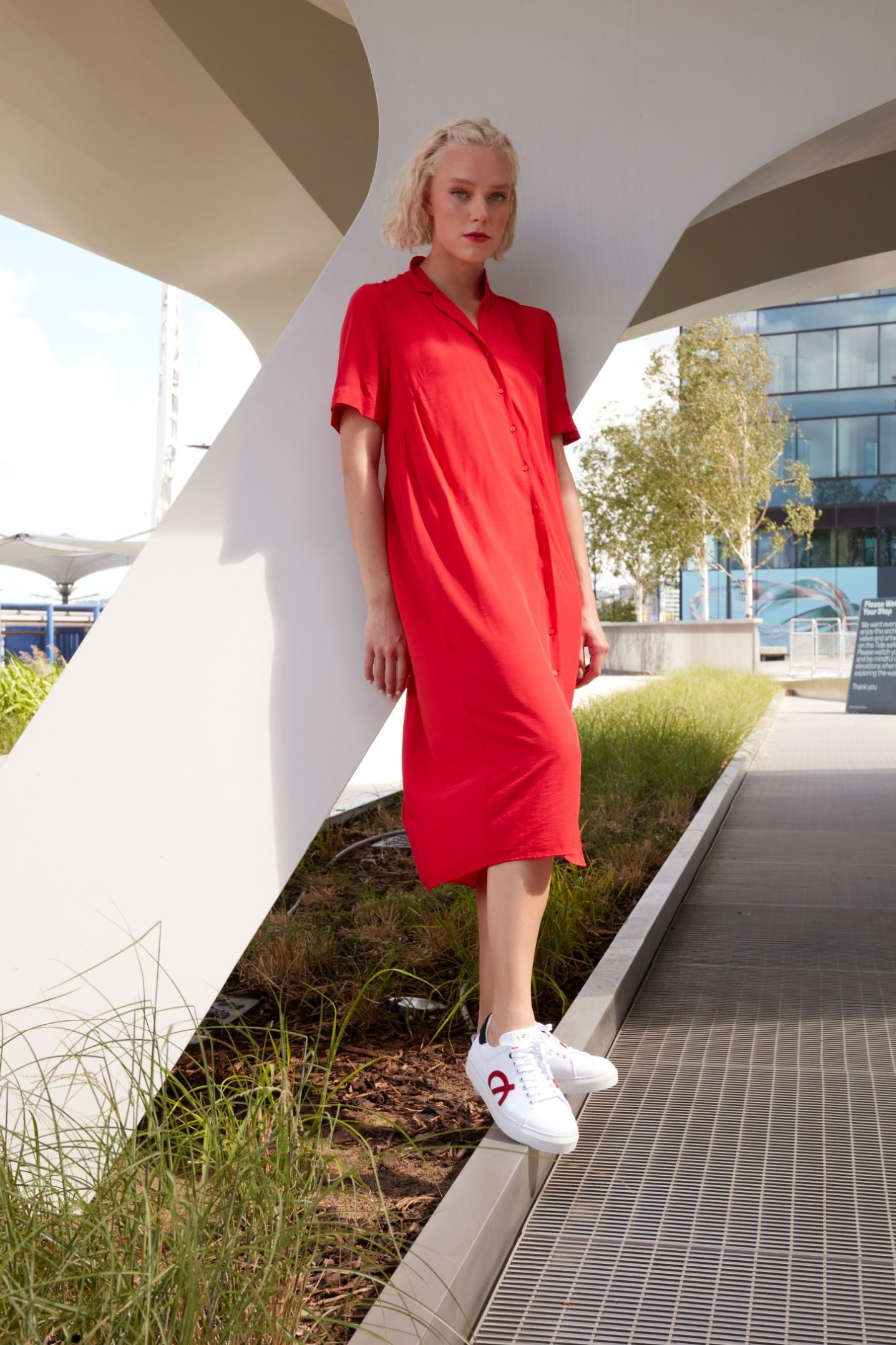
Choose a low-profile sneaker to elongate your silhouette.

Pick the perfect trainer silhouette for your midi skirt
Match the trainer profile to the skirt shape. Slim, low-profile trainers or sneakers preserve a fluid silhouette with full, A-line, or pleated midis, while chunkier, structured trainers add visual weight that suits straight or pencil midis. Pay attention to the hem-to-shoe junction: if the hem lands at the widest part of your calf, a low-cut trainer that reveals a sliver of ankle avoids a horizontal break; if the hem grazes the ankle, a higher-cut or high-top trainer creates a continuous line down the leg. Control perceived length with sole height: a raised sole or platform restores height and prevents a midi from shortening the leg, whereas a slim sole keeps the look streamlined. Try both options, standing side-on in a mirror or taking a quick photo, to judge whether added bulk balances or overwhelms your particular cut.
Choose toe shape and upper detail to create harmony. Rounded, minimalist trainers complement bias-cut and soft fabrics by keeping the eye on movement. By contrast, retro runners, angular toes, or panelled uppers introduce sporty structure that balances tailored or ribbed midis. Factor colour and texture into the silhouette: match the trainer sole or the visible ankle to your skin tone to visually extend the leg, or pick tonal trainers to soften contrast and lengthen lines. Vary materials, such as leather, mesh, or suede, to change perceived weight, and try combinations until you find the balance you prefer.
Choose a sculpted cushioned sole to lengthen your line.

How to reveal your ankle: cropped hems, side slits, and visual breaks
Position the hem either below the widest part of your calf or above it so the ankle remains visible. Stand, find the narrowest point above your ankle, and mark it, then set the hem to leave a deliberate gap between trainer and skirt. Add a side slit or a small centre-front vent to introduce a vertical line; even a modest split reveals the ankle in motion and visually lengthens the leg, helping to balance a fuller midi. Create a horizontal break higher on the body with a cropped jacket, a tucked top, or a defined waistline to shift visual weight upward, so the ankle reveal reads as intentional rather than disproportionate.
Match the trainer's bulk to the skirt silhouette by pairing chunky trainers with a narrower hem, and streamlined trainers with fuller skirts. Check proportions from the side and walk to ensure the ankle gap stays visible in motion; adjust hem placement or shoe bulk if the skirt rides up or the trainer hides the ankle. Keep the trainer-to-skin transition clean with low-profile, no-show liners or a thin ankle strap; this creates a narrow band of skin that prevents chunky soles from overwhelming the leg.
Reveal the ankle with crops, splits and visual breaks
- Hem and split variations: stand and mark the narrowest point above your ankle, then set the hem to sit either just below the widest part of the calf or at that narrow point so a deliberate gap appears between shoe and skirt; use a modest side slit, a small centre-front vent, an asymmetric hem, or a high-low front (around 4–8 centimetres shorter) to reveal the ankle in motion and visually lengthen the leg.
- Shoe and sock pairings: match trainer bulk to the skirt silhouette by pairing chunky trainers with a narrower hem and streamlined low-profile trainers with fuller midis; keep the trainer-to-skin transition clean with no-show liners, low-cut socks, or a thin ankle strap so a narrow band of bare skin prevents chunky soles from overwhelming the leg.
- Proportion and layering tricks: create a horizontal break higher on the body with a cropped jacket, a tucked top, or a defined waistline to shift visual weight upward; belt at the natural waist or crop to just above it, and add vertical details such as centre seams or vents to balance volume and make the ankle reveal read intentional.
- Motion test and quick tweaks: walk and check the outfit from the side to ensure the ankle gap remains evident; if the skirt rides or the trainer obscures the ankle, adjust hem placement by a centimetre or two, swap to a slimmer trainer, or lengthen a slit slightly to restore the reveal.

Anchor voluminous dresses with layered silhouettes and grounded trainers
Create a clear, narrow point at the waist to balance a full midi. Use a cropped jacket or a belt at the natural waist to reduce skirt bulk. Choose structured layers to resist the flow of a floaty dress, and soft layers to amplify it. Match trainer sole weight to the dress silhouette. A thicker, heavier sole anchors a voluminous midi, while a slim, low-profile trainer preserves a clean vertical line on straighter styles. Try the pairing in a mirror and notice whether the eye stops at the hem or continues down the leg. Adjust the waist definition or the sole profile until the focal point lands where you want it.
Manage layer lengths so they do not cut across the skirt at its widest point. Layers that finish above that section create a visual break and trim perceived width, while layers that extend beyond the hem preserve uninterrupted vertical lines. Fine-tune the look with accessory and ankle choices: matching the trainer colour to tights or hosiery helps elongate the leg, and a narrow belt or compact bag draws attention to a defined midsection. Experiment with the height of ankle coverage, belt width, and compact outerwear to direct attention to different areas.
Anchor voluminous midis with a structured, modern sneaker.

Finish every outfit with accessories, colour, and texture for cohesion
Echo a colour from the midi into accessories and trainers to make separate pieces read as a single outfit. Introduce that hue on a bag strap, belt, or lace trim to lead the eye. Layer contrasting textures to add depth: pair satin or silk with a matte or suede-effect trainer, then add a third texture, such as a knitted scarf or leather belt, to harmonise surfaces and stop the look feeling flat. Match accessory scale to dress volume — wider belts, chunkier bracelets, and larger bags for pleated hems; delicate necklaces, thin belts, and small crossbody bags for slim, column silhouettes.
Anchor voluminous dresses by placing darker, weightier accessories at the hem or waist. To lift a heavy look, add a pale or metallic piece near the face to redirect the eye. Step back a metre to check cohesion, then adjust accessory weight until the outfit reads as a single composition. Observe finishing details: visible ankle-length hosiery, the trainers' silhouette, and lace colour all change how proportion reads. When those elements match your skin tone or the trainer, they create an uninterrupted line that visually lengthens the leg; when they contrast, they introduce a deliberate break. Choose an ankle strap, ankle-length hosiery, or bare skin intentionally to control casualness and balance.
Balancing trainers with midi dresses comes down to proportion. Hem placement, trainer profile, and an intentional ankle reveal determine whether a pairing lengthens or shortens the leg. Try three quick checks: mark the narrowest part of your calf to see where the hem falls, swap a low-profile trainer for a chunkier sole to test visual weight, then stand a metre away and view the outfit at eye level to judge the overall silhouette. These simple trials reveal which pairings preserve the dress's intended line.
Treat hem length, trainer silhouette, ankle reveal, volume control, and finishing touches as a dressing checklist. Adjust waist definition, trainer collar height, and accessory scale to shift focal points. Try combinations in front of a mirror and while moving, and you will soon learn which small adjustments anchor a look, so you can stay comfortable without losing the midi’s intended silhouette.