

Article: What Does ‘Sustainable’ Mean on a Vegan Trainer Product Page?
What Does ‘Sustainable’ Mean on a Vegan Trainer Product Page?
When a vegan trainer product page says “sustainable”, treat it as a starting point, not a complete verdict. Vegan tells you that the product is intended to contain no animal-derived materials; it does not, by itself, tell you how the materials were made, who made the trainer, how long it will last or what happens when you finish with it.
This buyer’s checklist helps you separate three things: evidence you can substantiate, information that is useful but incomplete, and language that is too broad to compare. You do not need specialist knowledge or a perfect life-cycle assessment. You do need to look for the boundaries, percentages, dates and documents behind the claim.

1. Separate vegan status from sustainability
“Vegan” is a composition claim. It concerns animal-derived ingredients or components, including less visible elements such as adhesives, dyes, finishes, linings and threads. “Sustainable” is much wider: it may refer to environmental impact, resource use, labour conditions, durability, repairability or end of life. Those are related questions, but they are not interchangeable.
A product page can therefore document vegan status while giving only limited information about environmental performance or ethical manufacturing. That is not automatically proof of poor practice; it simply limits what you can confidently conclude. LØCI’s evidence-led checks for ethical, sustainable vegan trainers are a useful reminder to assess the whole product life cycle rather than one attractive label.


2. Read the materials breakdown, not just the headline
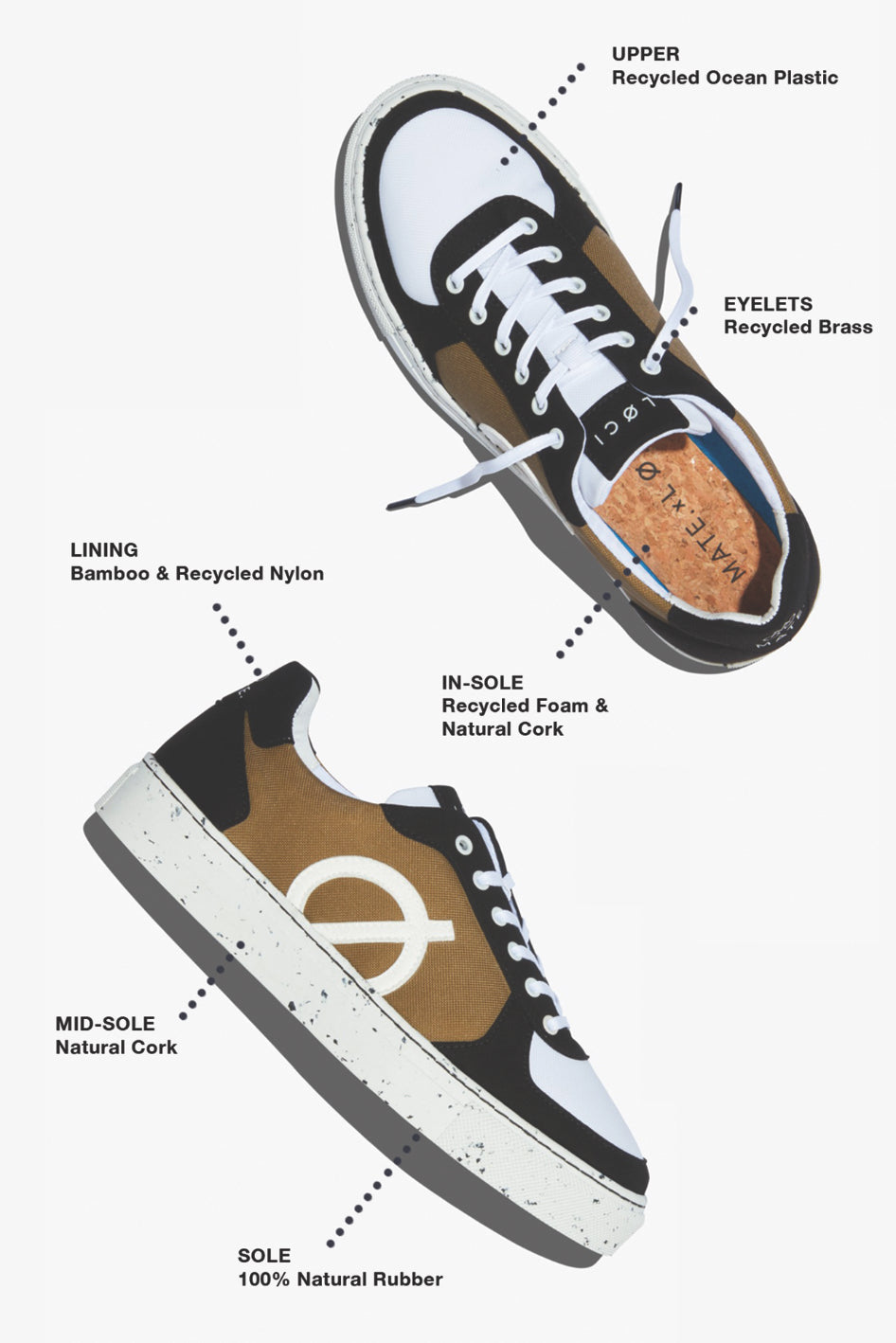
Look for a component-by-component account covering the upper, lining, tongue, insole, midsole, outsole, adhesives, trims, dyes and finishes. A phrase such as “made with recycled materials” may describe only one part of the trainer, so ask what the percentage refers to and whether it is measured by weight, by a component or across the finished pair.
Interpret material language carefully: recycled describes previously used material; plant-derived describes the source of a feedstock; renewable concerns how quickly a resource can be replenished; biodegradable describes a potential breakdown process under particular conditions; recyclable describes a technical possibility, not necessarily an available collection route. None of these words alone proves lower impact.
A stronger page names the material, percentage, source and relevant standard or test. It may also explain whether recycled content is post-consumer or post-industrial. Without those boundaries, two trainers using “30% recycled” may not be meaningfully comparable. For a broader product-page checklist, see LØCI’s five sustainability and ethical credentials to check when choosing vegan trainers.


3. Check certification, traceability and manufacturing
A certification is useful only when you can see what it covers. Check the issuer, certificate or licence details, issue date, expiry or review date, chain of custody and the exact materials, components, product or facility included. A vegan certification may support animal-free status; a recycled-content standard may verify input percentage and provenance; a factory or environmental-management standard may concern site practices. None necessarily guarantees the whole trainer is sustainable.
Manufacturing information adds another layer. Useful details include the country of manufacture, named factory or supplier, permitted subcontracting, audit scope, corrective actions, worker protections and chemical-management controls. Look for evidence that relates to the product’s actual supply chain rather than a company-wide statement. If a page names a standard but provides no scope, date or supporting document, record it as useful but incomplete, not as proof.
What good evidence looks like: manufacturing checks and gaps to notice
- Substantiated: a named factory or supplier, manufacturing country, audit scope and dated evidence covering labour, safety or chemical controls.
- Useful but incomplete: a country of manufacture or a general code of conduct without the facility, audit date, findings or corrective-action information.
- Unsupported or too vague to compare: “eco-friendly”, “ocean-friendly”, “carbon neutral” or “low impact” without a method, baseline, functional unit, date or measurable outcome.

4. Assess durability, care and end of life
A trainer’s impact is shaped by how long it remains useful. Product pages do not always publish expected wears or laboratory results, but you can look for relevant indicators: abrasion and flex testing, sole-bonding information, reinforced high-wear areas, replaceable insoles, accessible stitching and construction that can be repaired rather than discarded. Ask the brand which test method was used and whether the result applies to this model, not just to a material sample.
Care guidance is evidence too. Clear instructions for cleaning, drying and protecting the materials can help prevent premature replacement. Repair options are stronger still: check whether the brand offers repairs, replacement laces or insoles, resoling, spare parts or advice from a named partner.
Be precise about end of life. “Recyclable” may mean a component can technically be processed, while the finished trainer may be difficult to separate and your local authority may not accept it. A realistic route names who takes the pair, where it can be returned, what happens next and which components are recovered. Take-back, recycling or compostability claims should include conditions and intended outcomes, not just a green symbol. Together, these checks show whether a product’s useful life and next step are being treated as practical questions rather than broad promises.


FAQ: common questions before you buy
Does vegan automatically mean sustainable? No. Vegan status addresses animal-derived content, while sustainability also involves material impacts, manufacturing, durability, care, repair and end of life.
Does recycled content prove lower impact? No. Ask what the percentage covers, whether the input is post-consumer or post-industrial, where it came from and which method or certificate supports it. Compare percentages only when their boundaries are alike.
Does a certification guarantee the whole trainer? No. Check the issuer, date, chain of custody and scope. A certificate may cover one material, component, factory or vegan status rather than every part and process.
What should you do when a product page does not provide enough evidence? Treat the claim as incomplete rather than automatically false. Ask focused questions about the missing detail, then research further or choose a pair with clearer documentation if the answer remains vague.
Before you click “buy”, make a simple judgement: substantiated, useful but incomplete, or unsupported and too vague to compare. Focus on the missing detail that would most change your decision, such as the full composition, recycled-content scope, factory evidence, durability data or end-of-life route.
If that detail matters to you and the brand cannot provide it, treat the claim as unresolved rather than filling the gap with assumptions. The better choice is the pair whose evidence is clear enough for the decision you are actually making.