
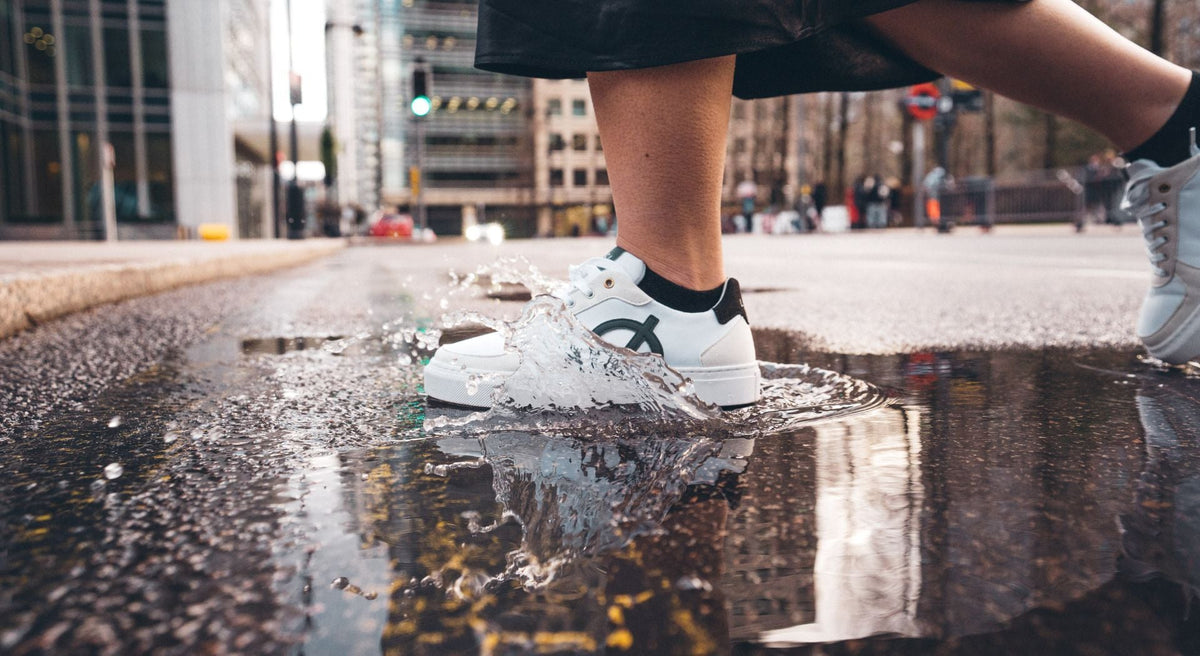
Can everyday vegan trainers handle wet pavements?
Yes, often for damp pavements and a brief shower, provided the pair has sensible grip, a suitable upper and sound construction. But “vegan” describes the material choice, not a waterproof rating or a promise of traction. Wet-weather performance comes from the whole shoe: outsole compound and contact, tread, upper, tongue, seams, eyelets, collar and the upper-to-sole join.
For an ordinary British commute, judge the forecast and route before the label. A lifestyle trainer may be a practical choice for drizzle, damp paving and short wet spells, yet the same pair may be a poor choice for persistent rain, standing water, ice, deep mud or conditions where certified waterproof protection matters. Surface beading is only an indication of water behaviour, not proof that water cannot enter or that the shoe will stay dry for hours.

Start with the claim: water-repellent is not waterproof
Water-repellent usually means water tends to bead and roll off a surface for a time, often because of a finish or a naturally less absorbent material. Water-resistant is broader: it may slow water entry, but the duration and pressure it can handle vary. Neither term automatically means the trainer will stay dry in prolonged rain.
Waterproof should be a specific, supported product claim, ideally accompanied by details about the construction or testing behind it. A waterproof membrane can block liquid water while allowing some vapour to escape, but it is only part of the story: seams may need taping or sealing, and the tongue, lace area and collar still need protection. If the product page does not explicitly support waterproof performance, do not infer it from a coated upper, a photograph or a few beads of water.


Inspect the outsole: grip is more than a bold pattern
Look at the outsole from the side and underneath, then consider how it feels when you gently flex the trainer in your hands. A road-oriented outsole with reliable contact, a suitable rubber-like compound and defined but not excessively deep tread can be a sensible starting point for damp pavements. Shallow grooves or siping, which means small cuts that create additional edges, may help a sole conform to a surface, but a pattern alone cannot guarantee traction.
Pay attention to the compound as well as the drawing. Very hard material can feel less reassuring on some smooth wet surfaces; very soft material may wear faster. Worn-down flex grooves, polished patches, loose edges or a sole that has hardened with age are reasons to reduce confidence. Wet pavement is not one condition: smooth stone, painted markings, leaves, oil, mud, ice and deep water each change the risk. Check grip cautiously on ordinary ground; never turn a home inspection into a deliberate slip test.


Compare upper materials: shedding water versus breathing well
Mesh and knit uppers usually prioritise airflow and flexibility, but their open structure can allow water to reach the sock more quickly. A tightly woven textile may slow surface wetting while retaining some breathability. Coated textile, microfibre and plant-based or synthetic leather-style panels can shed surface water more readily, though a coating may reduce airflow and can still fail at unprotected joins or flex points.
Treat these as trade-offs rather than a league table. A covered upper may be more comfortable in a shower but warmer indoors; a breathable upper may dry faster after a small splash but offer little barrier against sustained rain. Product descriptions can help you identify the material, yet they do not prove long-duration weather performance unless the brand gives explicit construction or testing information.

Find the weak points: seams, tongue and sole join
Water often enters through the details rather than the centre of the upper. Inspect stitching, overlays, lace eyelets, the tongue, collar and the line where the upper meets the sole. A gusseted or well-overlapped tongue can offer more protection than a loose, open lace area, but do not assume a feature is sealed unless the product information says so.
Look for lifting edges, cracked coatings, gaps at flex points, exposed stitching and compressed padding. On an existing pair, flex the trainer gently and check whether bonded areas open or creak. These checks can reveal wear and likely weak points; they cannot certify waterproofing, replace manufacturer testing or tell you how the shoe will perform under sustained water pressure.

Use cautious home checks before a wet commute
Before a wet commute, run this short final check rather than repeating the full inspection: confirm the forecast and route, make sure the outsole still has even contact and usable grooves, and look once over the upper, seams and sole edge for fresh damage. A few drops that bead or absorb only describe surface behaviour at that moment, not waterproof performance.
Check fit, comfort and drying time too. Wear the pair on a normal walk before relying on it for a long commute. If you use a protector, confirm that it suits the specific upper, test it on an inconspicuous area and follow the product’s care guidance. It may support water repellency or stain resistance, but it cannot turn an everyday lifestyle trainer into a sealed waterproof shoe.

Set the weather limit: match the trainer to the route
Use the forecast, route and consequence of getting wet rather than a simple yes/no rule. Damp pavements, drizzle and a short shower are generally the sensible use case for a well-fitting everyday trainer with intact grip and no obvious construction damage. Prolonged rain, repeated puddles or water rising over the collar call for more protection and a realistic drying plan.
Standing water, flooding, snow and ice are different categories, not harder versions of the same test. Deep mud and technical trails need footwear designed for terrain; demanding hikes need appropriate support and durability; work environments may require certified protective footwear; and cycling-specific riding may call for activity-specific grip, visibility or cleat compatibility. If a slip or wet feet would carry serious consequences, choose the purpose-built option.

Care after rain: protect the materials and the bond
Remove loose grit before cleaning, then follow the trainer’s own care instructions for its upper, lining and sole. Use a soft cloth or brush and a compatible cleaner where appropriate; do not assume every coating or plant-based material responds well to the same product.
After a wet commute, loosen the laces, remove the insoles if the instructions allow and air-dry the trainers slowly in a ventilated place away from radiators, hairdryers and direct heat. Heat can affect adhesives, coatings, shape and finishes. Give the pair time to dry fully before the next long walk. Good care can extend useful life, but it does not add a waterproof membrane or restore tread that has worn away.

Keep, carry a second pair or replace? Use a three-way decision
Keep the pair in rotation when the fit remains comfortable, the outsole still has a consistent contact pattern, the tread is not visibly exhausted and the seams, tongue and bonded areas are intact. Protect it from weather beyond its limits rather than replacing it because it encountered one light shower.
Carry or buy a second pair when your week regularly combines office-ready style with long wet walks, when drying time is limited, or when one pair must serve two incompatible jobs. A second pair can be a better match for your routine and help each pair dry fully between wears.
Replace the pair when grip has become unreliable, grooves are worn smooth, the outsole is separating, the upper is cracking, or water reaches the foot through deteriorated seams or joins during ordinary use. Replacing only when performance and condition justify it supports longer, more considered wear.
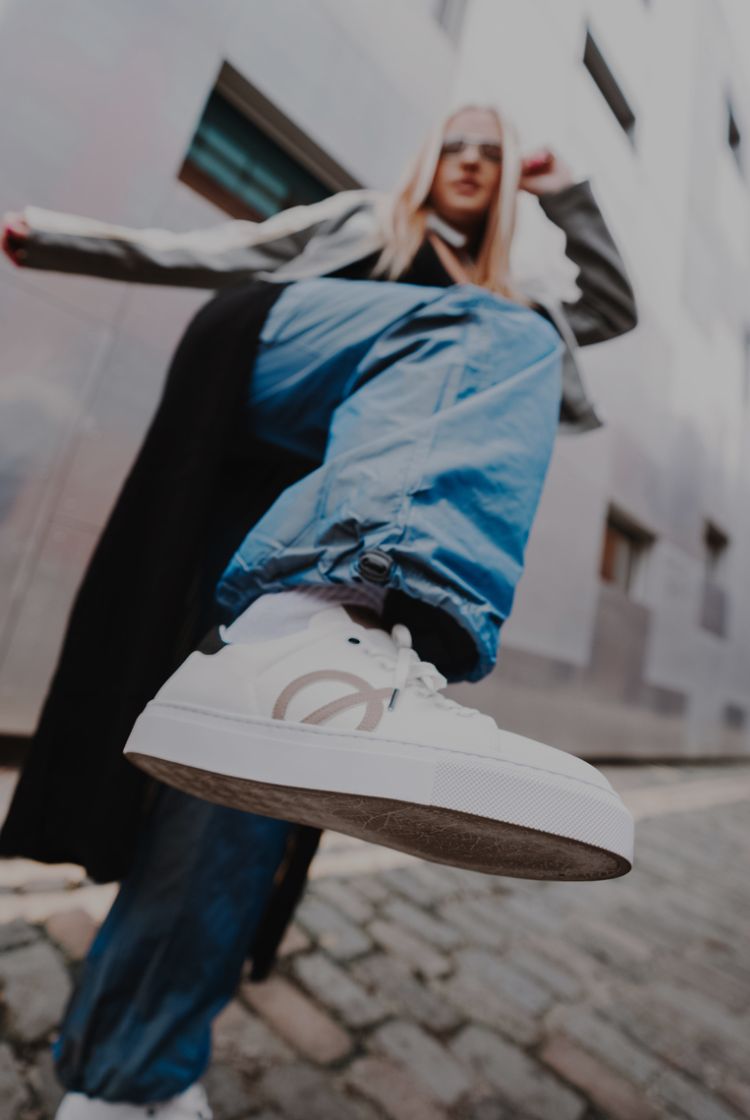
Style references: ØRIGIN Black/White represents a classic tennis-inspired everyday direction, while VŌLT is the lighter, active-leaning example made from recycled ocean plastics. Treat both as style and use-case references, not as waterproof guarantees, and verify the live product pages for current composition, fit and care details.

FAQ: vegan trainers and wet-weather use
What should a product page say before I call a pair waterproof? Look for an explicit waterproof claim supported by relevant construction or testing information. If the page only names a coated, synthetic or vegan upper, describe it more cautiously as a material or possible water-shedding feature, not as waterproof footwear.
How can I decide whether an existing pair still belongs in rotation? Keep it for ordinary damp conditions while the fit is comfortable, the tread remains usable and the seams, sole edge and bonded areas are intact. Reduce its weather exposure or replace it when grip, structure or water protection has visibly deteriorated.
Is a second pair worthwhile? It can be sensible if one pair must cover office wear, long wet walks and limited drying time. Matching different pairs to different routines can extend their useful life and avoid relying on a lifestyle trainer beyond its limits.
When should I choose specialist footwear? Choose purpose-built waterproof footwear for persistent rain or standing water, insulated footwear for cold exposure, trail footwear for technical ground, protective work footwear for hazardous environments and cycling-specific footwear where the activity demands features a lifestyle trainer does not provide.

The practical answer: judge the whole trainer, then the forecast
Everyday vegan trainers can work well for damp British pavements and light showers when their construction suits the conditions. Match the pair to the forecast and route, and choose specialist footwear when the weather or consequences demand more protection.
Look after suitable trainers, let them dry fully and replace them when their grip or construction can no longer be trusted. That simple rule supports comfortable, transparent and more sustainable use.